Springfield basements have a standing appointment with water. Our springs bring multi-day rains that saturate clay soil until it pushes groundwater against every foundation in the metro; the water table rises across south Springfield and the Galloway lowlands; and karst limestone under the whole region moves underground water in ways that surprise homeowners blocks from any creek. A sump pump is the basement's answer — and a sump pump that fails during the storm that needs it is worse than none, because it postponed every other precaution.
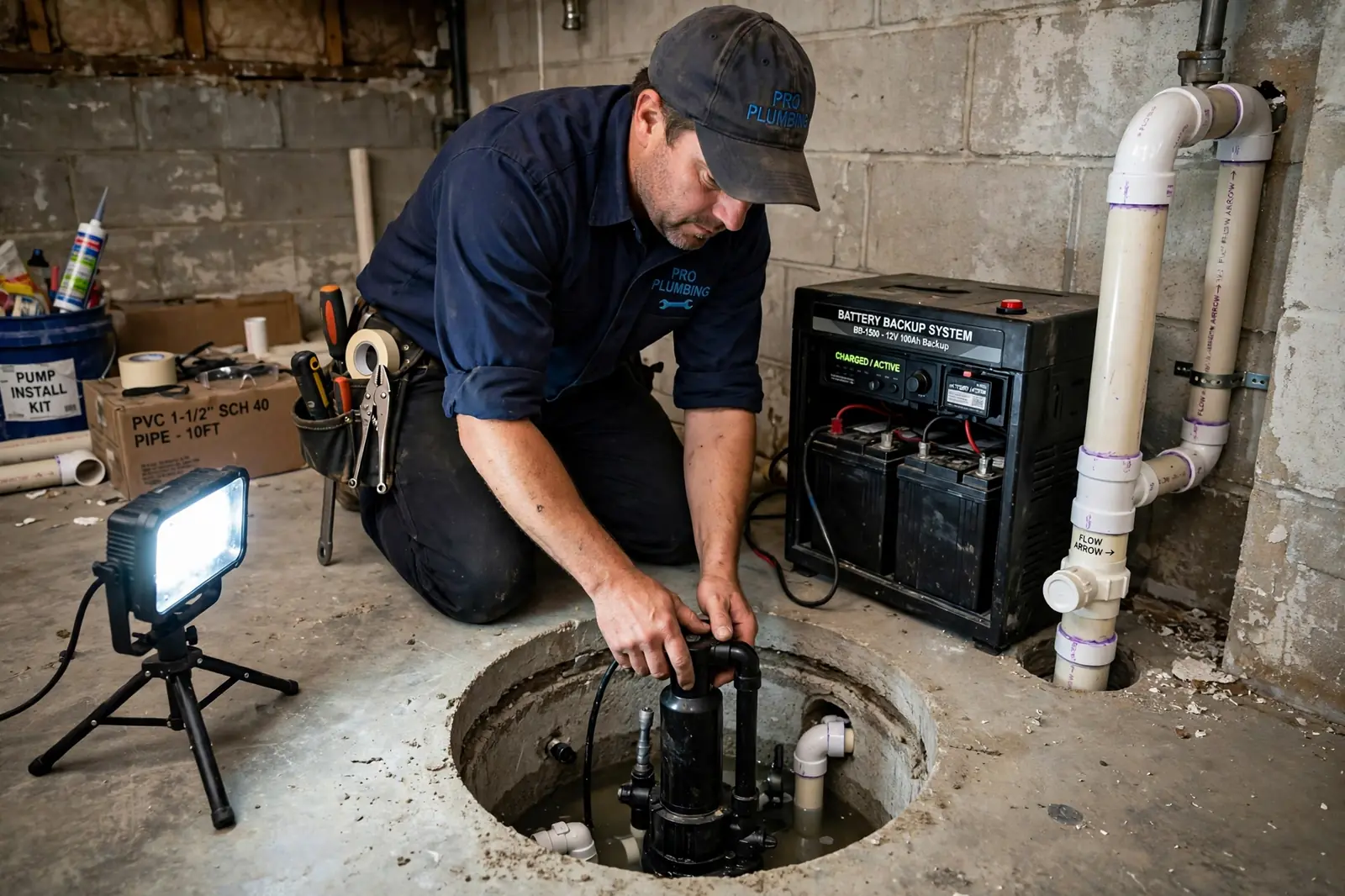
Plumber installing a sump pump with battery backup in a Springfield basement.
Springfield Emergency Plumbing installs and replaces sump pumps across the metro — correctly sized primary pumps, sealed basins, check valves that actually check, and battery backup systems that keep pumping through the power outages Ozarks storms reliably deliver. Every installation is tested under real water before we leave.
Signs Your Basement Needs a Sump Pump — Or a Better One
Water seeps in during heavy or multi-day rain
Damp corners, efflorescence lines on the walls, or actual puddles after Springfield's spring rains mean groundwater is winning against your foundation. A sump system intercepts that water below the floor and sends it out — before it becomes your problem upstairs.
Your existing pump is loud, short-cycling or over seven years old
A pump that rattles, cycles every few minutes, or runs constantly in wet weather is undersized, failing or both. Sump pumps are storm equipment with a working life of roughly 7–10 years; past that, replacement on a dry Tuesday beats failure on a flooded Saturday.
The pump has no battery backup
The storms that fill your sump pit are the storms that knock out power — Springfield learned that in the 2007 ice storm and relearns it every tornado season. A primary pump without backup is protection that resigns exactly when it is needed.
The pit is open, uncovered or smells
An open pit evaporates moisture into the basement, admits radon and debris, and lets objects fall onto the float switch — a classic cause of pumps that never turn on. A sealed, gasketed cover is part of a correct installation, not an accessory.
The check valve chatters or the line refills the pit
When the pump stops, the water in the discharge line should leave — not fall back into the pit to be pumped again. A failed check valve doubles the pump's work and halves its life; you can hear it as a bang or a pit that refills instantly.
You finished — or are finishing — the basement
Drywall, flooring and furniture multiply what a basement flood costs by ten. A sump system with backup, installed before the finish work, is the cheapest insurance a finished Springfield basement can carry.
How Our Sump Pump Installation Works
1
We assess the water, not just the pit
Existing pit or new, we look at where the water actually enters — floor-wall joints, under-slab pressure, drain tile condition — and at your discharge route. The right pump size and basin setup follow from your basement's water, not a shelf default.
2
Flat quote: pump, basin, backup, discharge
One price for the defined system: basin work if needed, primary pump, check valve, sealed cover, battery backup unit if chosen, and discharge piping routed to a proper exterior exit away from the foundation.
3
Installation done to hold up in a storm
The pump is set level on a stable base, the float given free travel, the discharge glued and supported, and the backup pump set slightly higher than the primary so it only runs when it is truly needed — or when the power is out.
4
Tested with real water, alarms armed
We fill the pit and run the system through full cycles, then kill the power and watch the battery backup take over. High-water alarms are tested too. You see the whole system work before we consider it installed.
5
A simple maintenance routine, in writing
Quarterly float checks, an annual pit cleaning, and a battery replacement window — sump systems fail from neglect more than from defects. We leave you the short list and the install date, and we are glad to fold the annual check into a visit you already have scheduled.
What a Sump Pump Installation Costs in Springfield
In the Springfield area, replacing a sump pump in an existing pit typically runs $350–$750 installed for a quality primary pump; a full new installation with basin excavation in a basement without a pit runs $800–$1,800 or more depending on concrete work and discharge routing; and a battery backup system adds roughly $400–$900 installed — the component that decides whether any of it works during a storm outage.
Set that against the alternative honestly: a flooded finished basement in this metro is a five-figure event between mitigation, flooring, drywall and belongings — and it reliably happens during the same storms that cut power. A primary pump plus battery backup, tested yearly, is the whole defense, and it costs less than the deductible conversation that follows skipping it.
Why Springfield Homeowners Choose Springfield Plumbing
We install sump systems the way Springfield weather demands: sized for multi-day rain, backed up for the outage that comes with it, and tested under real water in front of you. A sump pump is invisible equipment that only matters on the worst night of the year — our job is making sure that on that night, it is the most reliable machine in your house.
How much does sump pump installation cost in Springfield, MO?
A replacement pump in an existing pit typically runs $350–$750 installed. A complete new system with basin runs $800–$1,800+, and battery backup adds about $400–$900. Every installation is quoted flat after we see your basement and discharge route.
Do I really need a battery backup sump pump?
In Springfield, yes — the heaviest sump demand arrives with storms, and storms cut power. The 2007 ice storm left parts of this metro dark for over a week. A battery backup keeps pumping for hours to days depending on inflow, and it also covers you if the primary pump itself fails mid-storm.
How long does a sump pump last?
A quality primary pump lasts about 7–10 years in typical Springfield service; heavy-run pits shorten that. Backup batteries need replacement roughly every 3–5 years. If your pump is past seven years, sounds rough, or cycles oddly, replacing it before storm season is the economical move.
Where should sump discharge water go?
Out and away from the foundation — far enough that it does not simply soak back to the footing, and not onto a neighbor's property or into the sanitary sewer, which Springfield code prohibits. We route discharge to a proper exterior exit as part of every installation.
My basement only gets water once every few years. Is a pump worth it?
That is exactly the profile that benefits most — rare, heavy events are what sump systems exist for, and 'once every few years' in the Ozarks tends to mean one very large bill when it happens. An unfinished basement with a pump and backup is protected for a fraction of one flood's cleanup cost.
Need Sump Pump Installation in Springfield?
A burst pipe pours hundreds of gallons an hour and a sewer backup will not wait for morning. We answer 24/7 across Springfield and the Missouri Ozarks — call now and stop it from getting worse.