Multiple drains slow or backing up together
When the problem is the main line, every fixture upstream of the blockage complains at once — and the lowest drain in the house, usually a basement shower or floor drain, is where sewage appears first.
Your sewer line is the hardest-working pipe you own and the easiest to forget — until it reminds you, through a basement drain, that everything leaving your house travels through one aging line buried in Ozarks rock and clay. Springfield's older neighborhoods run on clay and cast-iron sewers installed half a century or more ago, and the metro's magnificent mature trees have spent those decades sending roots into every joint. Add clay soil that swells and shrinks with our wet springs and dry summers, shifting and cracking rigid pipe, and sewer failure here is a matter of maintenance and timing, not bad luck.
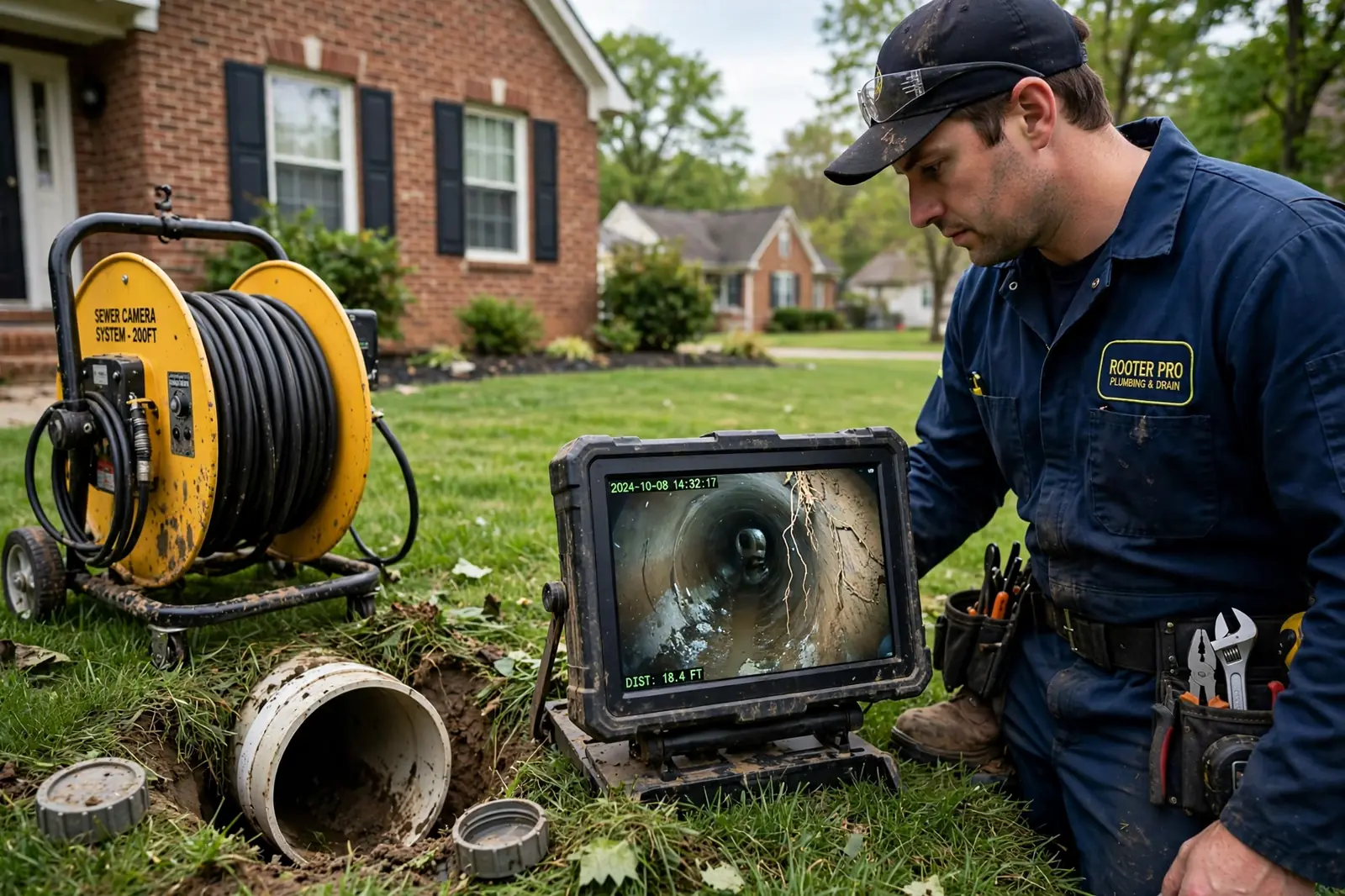
Springfield Emergency Plumbing diagnoses sewer lines by camera first — you watch the inside of your own line on screen with us — then quotes the repair that fits the damage: root cutting and treatment, a sectional repair, trenchless lining, or full replacement, each priced flat before digging starts.
When the problem is the main line, every fixture upstream of the blockage complains at once — and the lowest drain in the house, usually a basement shower or floor drain, is where sewage appears first.
A line that leaks underground announces itself by odor before anything surfaces. A persistent sewer smell near the line's path — especially after rain works moisture through the soil — means the pipe has an opening.
Sewage is fertilizer. A band of grass along the sewer route that stays greener and faster-growing than the rest of the yard through an Ozarks summer is being fed from below — by your line.
A cleared line that blocks again within a month is telling you the pipe itself is compromised — roots regrowing through a cracked joint, a bellied section collecting solids, or a partial collapse. Clearing treats days; the pipe needs repair.
A leaking sewer washes soil from beneath footings and slabs as it drains. New cracks, doors that suddenly stick, or a sinking section of floor near the line's path can trace back to a line that has been leaking for years.
Much of Springfield's older housing drains through materials at or past their design life. Clay cracks and admits roots at every joint; cast iron scales and rots from inside. Age alone justifies a camera look before the emergency schedules it for you.
We run a sewer camera the full length of the line and review the footage with you: roots, cracks, bellies, offsets, collapse — or a healthy line that only needed cleaning. The diagnosis is evidence, not a sales pitch.
Roots in a sound pipe get cut and treated. A single failed section gets a sectional repair. A line that is cracked along its length but structurally round is a trenchless lining candidate. Only a collapsed or badly bellied line needs full open replacement — and we will show you why, on screen.
Sewer work is quoted as one number for the defined scope before digging begins — including depth, Springfield's rocky soil, and restoration of the excavation to grade. If we uncover genuinely unforeseeable conditions, we stop and discuss them with the camera running, not after the invoice grows.
The repaired line is camera-checked again after the work and flow-tested at full volume. You keep the before-and-after findings in writing — the documentation insurers, buyers and future you will all want.
Where the line remains in service after cleaning or root work, we set a realistic maintenance interval and root-treatment schedule, so the next visit is a planned cleaning instead of a holiday backup.
Sewer work in the Springfield area typically runs: camera inspection $100–$300 (often credited toward repair), root cutting and main-line cleaning $250–$600, a sectional spot repair $1,500–$4,000 depending on depth, trenchless lining roughly $80–$200 per foot, and full line replacement $3,000–$10,000 or more depending on length, depth and how much Ozarks rock the trench crosses.
Two honest notes. First, the homeowner — not the city — owns the line from the house to the main, including the section under the street-side yard, so these costs land on the property owner. Second, a camera inspection before any quote is not an upsell: it is the only way anyone, us included, can honestly tell a $400 cleaning from a $6,000 replacement, and we will never quote the second without showing you the first's evidence.
Sewer repair is where homeowners most fear being sold — the problem is underground, the numbers are big, and the evidence is usually taken on faith. We remove the faith from it. You watch your own line on camera, you see the damage measured and located, and you choose between options we price in the open. In a metro built on rock, clay and old pipe, that transparency is the whole product.
Ready when you are: call (417) 555-0147 for sewer line repair anywhere in Springfield, Nixa, Ozark, Republic, Battlefield and the rest of the Springfield metro.
It depends entirely on the damage, which is why we camera first. Cleaning and root cutting run $250–$600, a sectional repair $1,500–$4,000, trenchless lining about $80–$200 per foot, and full replacement $3,000–$10,000+. You approve one flat quote for a defined scope before digging.
The camera decides. Roots in an otherwise sound pipe need cutting and treatment; a cracked, bellied or collapsing pipe needs repair, and cleaning it will only buy weeks. We show you the footage and explain exactly which situation your line is in.
Lining installs a new pipe inside the old one through small access points — no full trench. It works when the existing line is cracked or root-invaded but still holds its shape. Collapsed or severely sagging lines cannot be lined and need open repair. The camera inspection tells us which you have.
The homeowner owns the lateral line from the house to the city main, including the part under the yard and sidewalk. The city owns the main itself. If the blockage is in the main, we will tell you — and that call is the city's to fix, not a bill for you.
Clay and older jointed pipe have seams every few feet, and roots follow the moisture and nutrients leaking from those seams — Springfield's mature oaks and maples are relentless about it. Cutting plus a root-treatment plan manages a sound line; a cracked line needs the joint eliminated by repair or lining.
A burst pipe pours hundreds of gallons an hour and a sewer backup will not wait for morning. We answer 24/7 across Springfield and the Missouri Ozarks — call now and stop it from getting worse.