Slow drains in more than one fixture
One slow sink is a local clog. Slow drains in several rooms mean the problem is downstream in a branch or the main line — and chemical cleaners poured into five drains will not fix one shared blockage.
Every drain tells you it is clogging long before it stops — the kitchen sink that drains a little slower each month, the shower standing in ankle water, the basement floor drain that gurgles when the washer empties. In Springfield, drains clog with the usual grease and hair, plus two local specialties: mineral scale from our hard Ozarks water narrowing pipes from the inside, and tree roots invading the clay and cast-iron sewer lines under the metro's mature, tree-heavy neighborhoods.
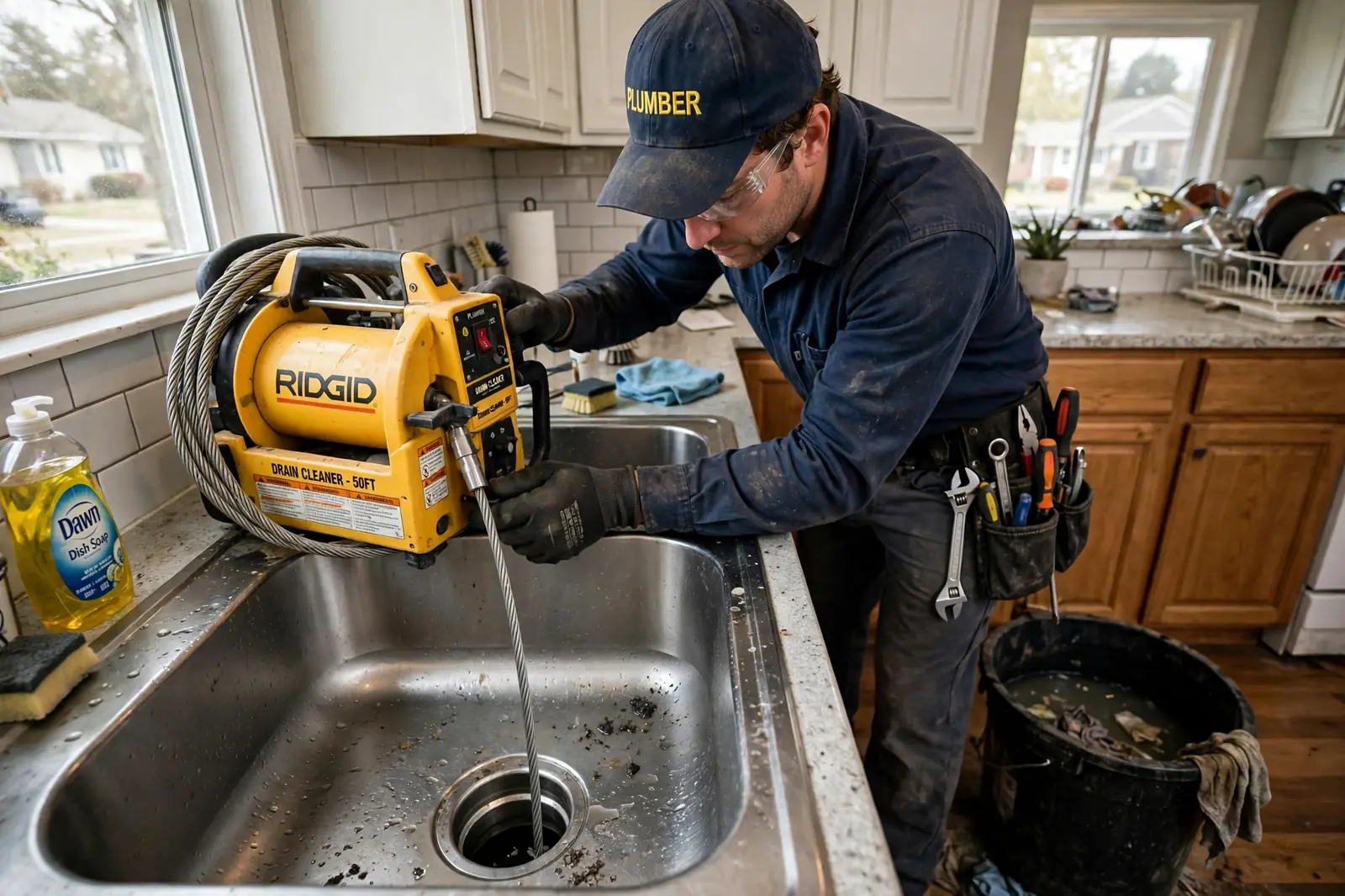
Springfield Emergency Plumbing clears drains the way they should be cleared: the right machine for the pipe, a camera inspection when the clog keeps coming back, and an honest explanation of what we found. No $99 bait pricing that triples on site — one flat quote before the auger ever turns.
One slow sink is a local clog. Slow drains in several rooms mean the problem is downstream in a branch or the main line — and chemical cleaners poured into five drains will not fix one shared blockage.
Gurgling is air being pushed and pulled through water by a partial blockage or a venting problem. It is the sound of a drain asking for help weeks before it backs up — the cheapest moment to call.
If running the washing machine sends water into the basement shower or floor drain, your main sewer line is restricted. That is a camera-and-machine job, and it gets worse — never better — with time.
A clog that returns every few months is not a clog problem, it is a pipe problem: scale buildup, a bellied section, a cracked joint or roots. Repeated snaking treats the symptom while the pipe quietly deteriorates.
Persistent sewer smell means gases are entering through a dry trap, a cracked line or a vent fault — and where sewer gas enters, the pipe has an opening it should not have. That opening only grows.
Drain flies breed in the organic film inside clogged, slow pipes. If they keep returning after cleaning the visible drain, the film — and the partial clog feeding it — is deeper in the line.
Fixture drain, branch line or main sewer — the symptoms tell us where to start, and we test before we machine. Clearing the right pipe the first time is the difference between a fix and a recurring appointment.
You get one price for clearing the line, quoted before work begins. If we find the pipe itself is damaged, we show you the camera evidence and quote the repair separately — the cleaning price never quietly becomes a repair price.
Hand and drum augers for fixture and branch lines, sectional machines with cutting heads for mains, and hydro-jetting where grease and scale need scouring off the pipe walls. Old cast iron and clay get the gentler treatment they require.
For main lines and repeat clogs we run a sewer camera after clearing: you see the roots, the belly, the cracked joint or the clean healthy pipe on screen with us, and you keep the findings in plain language.
Grease habits for kitchen lines, strainers for hair, a root-treatment schedule where trees are the issue, or a repair quote where the pipe is failing. You leave knowing why it clogged and what actually prevents the sequel.
Professional drain cleaning in the Springfield area typically runs $150–$350 for a single fixture or branch line, and $250–$600 for a main sewer line cleaning, with camera inspection commonly adding $100–$300 when it is needed. Hydro-jetting a grease- or scale-loaded main runs higher — usually $400–$800 — because it restores the pipe's full diameter instead of just punching a hole through the clog.
A straight talk note on chemical cleaners: on a fully stopped drain they almost never work, they sit in the pipe as a caustic hazard for the plumber who comes next, and on old Springfield cast iron and clay they can do real damage. If a drain is slow, a machine clearing costs less than the pipe repair a chemical habit eventually causes.
Anyone can rent an auger. The value is in knowing which pipe is blocked, which machine and head the pipe material can take, and whether the clog is the disease or just the symptom. Springfield's drains carry hard-water scale, mature-tree roots and seventy years of mixed pipe materials — we clean them with the method the pipe in front of us actually needs, and we show you the camera proof.
Ready when you are: call (417) 555-0147 for drain cleaning anywhere in Springfield, Nixa, Ozark, Republic, Battlefield and the rest of the Springfield metro.
Most single-drain cleanings run $150–$350; a main sewer line cleaning typically runs $250–$600. Camera inspection adds $100–$300 when needed, and hydro-jetting a heavily scaled or greased main runs $400–$800. You approve one flat price before we start.
Repeat clogs mean a pipe condition, not bad luck: hard-water scale narrowing the line, a sagging (bellied) section that catches solids, a cracked joint, or tree roots entering the sewer. A camera inspection shows which one you have, and we quote the actual fix.
For grease and scale, yes — jetting scours the pipe wall back to full diameter, while a snake mainly restores flow through the middle of the buildup. For a simple hair or object clog, a snake is faster and cheaper. We recommend the method your pipe and clog actually call for.
We advise against it, especially on Springfield's older cast-iron and clay lines. Chemicals rarely clear a full stoppage, they can damage aging pipe, and they leave a caustic pool that endangers whoever opens the line next. A machine cleaning is safer for the pipe and actually solves the problem.
Yes — main lines are some of our most common calls. If several fixtures are slow, the lowest drain in the house backs up, or you hear gurgling across rooms, that is the main line asking for a machine and usually a camera. See our sewer line repair page if the line itself turns out to be damaged.
A burst pipe pours hundreds of gallons an hour and a sewer backup will not wait for morning. We answer 24/7 across Springfield and the Missouri Ozarks — call now and stop it from getting worse.